- [16 October 2026](#)
- [ 4 min read ](#)
### Your AI Assistant Should Be Able To Ask Your Monitoring Tool Questions
***Built In Public: The Netglare Series, S1E2.***
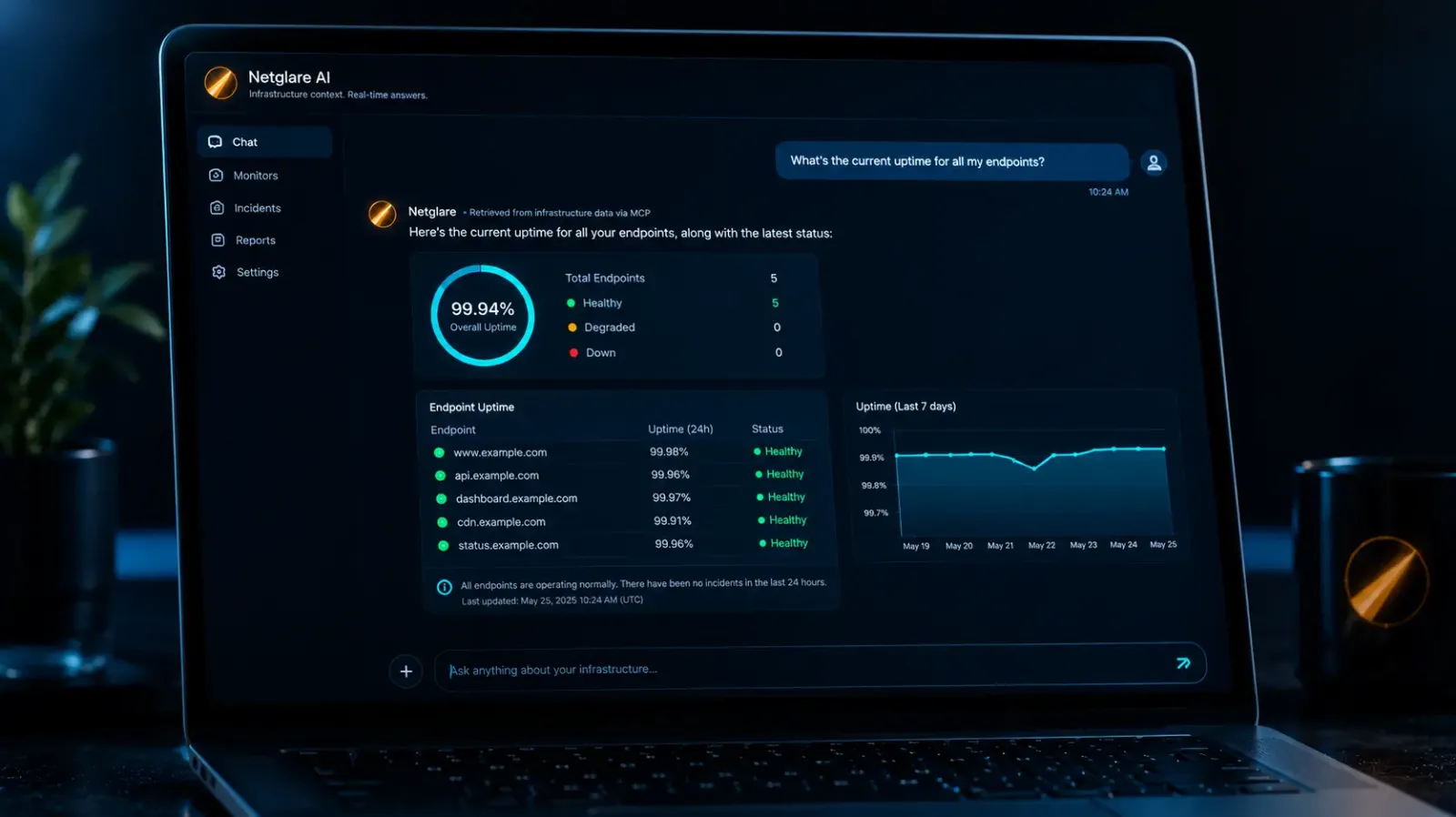
The short answer: MCP server infrastructure monitoring means a monitoring tool exposes its data through the Model Context Protocol, so an AI assistant can read your real uptime, incident and response time history instead of guessing. Netglare is building an MCP server on top of its REST API so that a question like “which endpoint was least reliable last month?” gets answered from your own monitoring data.
If you’ve asked an AI assistant about your infrastructure lately, you’ve probably received a confident, well-structured answer about how monitoring works in general, delivered with the calm of someone who has never seen your servers. The assistant isn’t being dishonest. It simply has no access to your data, and MCP is the standard designed to fix that.
## What is an MCP server?
The [Model Context Protocol is an open standard](https://modelcontextprotocol.io), introduced by Anthropic in late 2024, that lets AI assistants connect to external tools and data sources in a consistent way. The official specification lives at modelcontextprotocol.io. An MCP server is the piece a product builds so that any compatible assistant can ask it questions and get structured answers back. For a monitoring tool, that means the assistant can request uptime percentages, incident history or response times and receive real numbers.
### What problem does MCP server infrastructure monitoring solve?
The problem is context switching. You’re in the middle of a conversation with your AI assistant, a question comes up about last Tuesday’s performance, and answering it means leaving the conversation, opening a browser, logging into your monitoring tool, finding the right endpoint, adjusting the time range, reading the numbers and returning to explain them to the assistant. That’s four or five interruptions for one question. With an MCP server the assistant asks the monitoring tool directly, the data arrives in the conversation, and you stay where you were.
### Is Netglare the first monitoring tool with an MCP server?
No, and it would be odd to pretend otherwise. [Better Stack already offers an MCP](https://betterstack.com/docs/getting-started/integrations/mcp/) server that gives AI assistants access to its uptime and telemetry data, and smaller tools such as Vantaj have launched MCP servers that work with Claude and Cursor. The category is real and growing, which is exactly why we’re building into it rather than waiting.
What Netglare brings is a specific combination. Our MCP server will sit on top of ten sprints of work that most small-team tools haven’t combined: [alert grouping](/blog/beyond-the-alert-netglare-sprint-8-alert-grouping) that turns forty alerts into one incident, [response validation](/blog/server-monitoring-response-validation-netglare) that catches an endpoint returning 200 OK with the wrong content, TCP and DNS monitoring, and a [weekly digest](/blog/infrastructure-weekly-digest-sprint-9) that summarises each week’s performance. An assistant connected to that history can answer richer questions than one connected to a list of pings. We’re also aiming it at small engineering teams and agencies who already live inside their AI tools and don’t want an enterprise platform to get this.
### How is an MCP server different from a REST API?
A REST API is a general-purpose way for software to request data from another system, and it’s the foundation we covered in the previous episode about [building our REST API first](/blog/netglare-rest-api-foundation-2026). An MCP server is a layer built for AI assistants specifically. It describes what the product can do in a way an assistant can understand and use on its own, and it handles the back and forth of asking, receiving and following up. Practically, the REST API makes Netglare’s data available to any system you build, and the MCP server makes the same data available to the AI assistants your team already talks to. The second depends on the first, which is why the REST API comes first in the series.
### What will you be able to ask Netglare’s MCP server?
None of this has shipped yet, so these are the questions we’re designing for rather than features you can switch on today. Which of my endpoints had the most incidents last month? What did the response times on my API look like yesterday between 2pm and 4pm? Summarise last week’s infrastructure health before my Monday standup. Is anything currently degraded that I should know about before I deploy? Each of these is answered from your own monitoring history, which is the part a general-purpose assistant can never supply on its own.
#### Where this fits in the series
S1E1 covered the REST API that makes Netglare’s data available to any system. This episode covers the layer that makes it available to your AI assistant. Next comes SLA reporting, which is where agencies start turning monitoring into something they can sell.
---
If you’d like to follow the build, visit netglare.com, or write to getstarted@gatoblan.co to talk about what MCP access would mean for your team.
---
FAQs
What is an MCP server in simple terms?
It’s an adapter that lets an AI assistant ask a product questions and get real data back. For a monitoring tool, it means the assistant can read your uptime and incident history directly.
Does Netglare have an MCP server today?
Not yet. It’s planned for 2026, after the REST API it depends on. We’re building it in public, so progress will appear in this series.
What’s the difference between MCP and a REST API?
A REST API serves data to any software that asks for it. An MCP server packages that data in a form AI assistants can discover and use themselves. One is the foundation and the other is the conversation layer on top.
Which AI assistants work with MCP servers?
Any assistant or tool that supports the protocol. Claude and Cursor are common examples, and the list keeps growing as more tools adopt the standard.
Is it safe to let an AI assistant read monitoring data?
Our starting point is read-only access scoped by API key, which is the pattern other MCP servers use, so an assistant can look at your data without being able to change it.
Share: [](https://www.addtoany.com/share#url=https%3A%2F%2Fwww.gatoblan.co%2Fmarkdownify%2Fnode%2F64&title=Your%20AI%20Assistant%20Should%20Be%20Able%20To%20Ask%20Your%20Monitoring%20Tool%20Questions)